Showing posts with label ancient oaks. Show all posts

Tuesday, 26 June 2018

TREE-MENDOUS TREES in June

A warm, pleasant evening and over 40 people came on our tree walk round the park on Friday 22nd June at 7pm. We walked round seeking some of the less well-known trees as well as recognising the old, familiar characters. Parkland ornamentals as well as veterans make the trees of Mayow Park so special.
So that children would have a focus  (there were about 8 children there) a sheet with 12 tree names was handed to them. They had to find the trees as we walked round, give the trees a hug or try a bark rubbing, and remember the names of the trees they found. For each tree they received a nature stamp on their sheet.
We came to the black walnut tree Juglans nigra, planted in 1994 by the Friends of Mayow Park (known at that time as Mayow Park Users' group). A non-native tree, it can grow to over 30 metres high. It needs plenty of light and prefers a fertile soil.
Black walnut
Black poplar
Further along the meadow is the black poplar Populas nigra, donated and planted in 2012 by Glendale (the park contractors) to commemorate the Diamond Jubilee of Queen Elizabeth II's accession to the Throne. Black poplars can live up to 200 years and this is a native tree. There are other poplars in the park whose age we can only guess at and there was some debate about whether they had been planted before Mayow Park was created.
 
Majestic Cedar of Lebanon
The majestic evergreen Cedar of Lebanon, originating from Lebanon and the eastern coast of the Mediterranean, stands proudly looking down hill from its vantage point near the De Frene Road entrance.
We found Monkey Puzzle trees and lovely limes, a golden weeping willow and strong hornbeams.


A holm oak which has been a popular climbing tree through the generations. People now in their 40s and 50s bring their own children back to the park to share memories of this tree.
Horse chestnut is still a popular tree in autumn when children gather its conkers. How many can you find in the park?
Plenty of maples were planted in the park in the past, along the path edges.  Some have thrown up suckers and look more like maple bushes than trees. One has formed a den much loved by young children.
Maple den

We must not forget the wonderful veteran English oaks, Quercus robur, many of which were pollarded in bygone days. These are all older than the park and may have once been part of field boundary hedgerows. They are affectionately known as the boundary oaks.  This park has more than 20 such trees. Very old trees like these are valuable for wildlife. They contain dead wood particularly good for many beetles whose larvae feed on dead wood.  Holes also make good homes for nesting birds and small mammals.

One of the wonderful pollarded oaks
A copper beech, a blue cedar, a tulip tree and a tall Dawn Redwood, Metasequoia glyptostrboides, are some of the other specials in the park. To appreciate the dawn redwood in all its glory it is worth getting close up, to see the bark and the leaves. This is a deciduous conifer, shedding its leaves every autumn.
Dawn Redwood 

Tuesday, 27 June 2017

TREE LOSES LIMB May 2017

Mayow Park has an impressive number of pollarded boundary oaks, planted between 250 and 300 years ago to mark field boundaries, before the existence of the public park we know today.
Boundary oaks indicate a once common farming practice to mark land and field boundaries in the same way as walls and fences.

Pollarding is a pruning method used for centuries to manage trees. The upper branches are removed when the tree is still young and in the case of these ancient boundary oaks they develop new upward-growing branches which over the centuries become as thick as mature trees and look like respectable tree trunks in their own right.
 Daniel Greenwood (from Sydenham Hill Wood, a stone’s throw from our park) has written about boundary and pollard oaks in nearby areas and you can read his fascinating article about some of the trees here:  https://danieljamesgreenwood.com/tag/boundary-oak-trees/
 So Mayow’s ancient oaks reflect past local land management, while providing habitats for a large number of flora and fauna today. Birds, small mammals and invertebrates make their homes in the hollows, fungi and mosses find somewhere to grow. The trees contribute to the character of the park and park users have often said that the Mayow trees are valued in making the park landscape so special.
When a lovely tree that has stood for centuries loses a major limb many of us express sadness, as happened to a pollarded oak in Mayow Park on 19th May 2017. A local resident posted a photo to Friends of  Mayow Park Facebook group, thus alerting park users and the park maintenance team.

Tree alert. Photo by K Andreakou
The tree that lost a limb had the widest girth of any of the ancient trees in the park as measured on a tree walk in 2016.  Word quickly spread. Soon adults and children were seen clambering over the fallen limb and around its broad branches,  enjoying the opportunity to get close and personal.   A tree that probably few had noticed became a celebrity overnight. It was lovely to see how people engaged with the tree. But current concerns about health and safety, with the risk of someone falling and injuring themselves, was too great. Something had to be done.                                                                                                            
Clambering around a fallen tree
Heavy branches of the fallen limb hidden by dense foliage           
                                
Within a week a team of arboriculturalists from Sevenoaks arrived to make the broken limb ‘safe’. 
photo K Andreakou
Photo K Andreakou
Photo K Andreakou
These guys are clearly skilled at their job.  They explained their intention to leave most of the thicker branches on the ground to create wildlife habitats. Some of the thinner branches were taken to use as path edge markers along the woodchip path adjacent to the dawn redwood tree. Other branches were relocated by volunteers from Friends of  Mayow Park into a locked woodland nature area for wildlife, out of reach of human interference. And the thinner branches were shredded.


Broken limb still attached to parent tree by a small fragment of wood and bark

Concerns were raised by park users: maybe this tree is diseased because the heartwood of the broken limb was powdery brown sawdust? 

Powdery hollow heartwood


Without scientific knowledge about ancient oaks, I am inclined to the view that the collapsed limb may be due to old age, to the natural hollowing out of the inner trunk and to being a pollard with heavy limbs that lean out from the tree. I hope someone with greater knowledge can come forward to suggest some reasons for this fail. Meanwhile, the exposed inner core can provide a home to solitary bees, beetles and other invertebrates while the tree continues to live.
Looking around at other ancient oaks in Mayow Park, regular park users will recall that in July last year a mature oak split in two and needed urgent surgery. It now stands as a monolith tree where the whole crown was removed. Tree surgeons pruned it to remain standing as a monolith tree, allowing natural decay processes to continue for wildlife. Remarkably, it survives and has started producing new growth with side branches.
Not far from the monolith tree is the ‘lightning tree’. Hit by lightning a few decades ago, it lost most of its crown, thus exposing its hollow interior. It continues to survive, with growth only on one side of the trunk. 

These individual ancient trees contribute to the value of the park. Regular visitors recognise them, plants and animals colonise them and they recall land management history as pollarded and boundary oaks. 

(Photos by K Andreakou and A Sheridan)

Thursday, 12 January 2017

Pollard oak gets a trim

There is a large pollarded oak tree between the tennis courts and the bowls green.
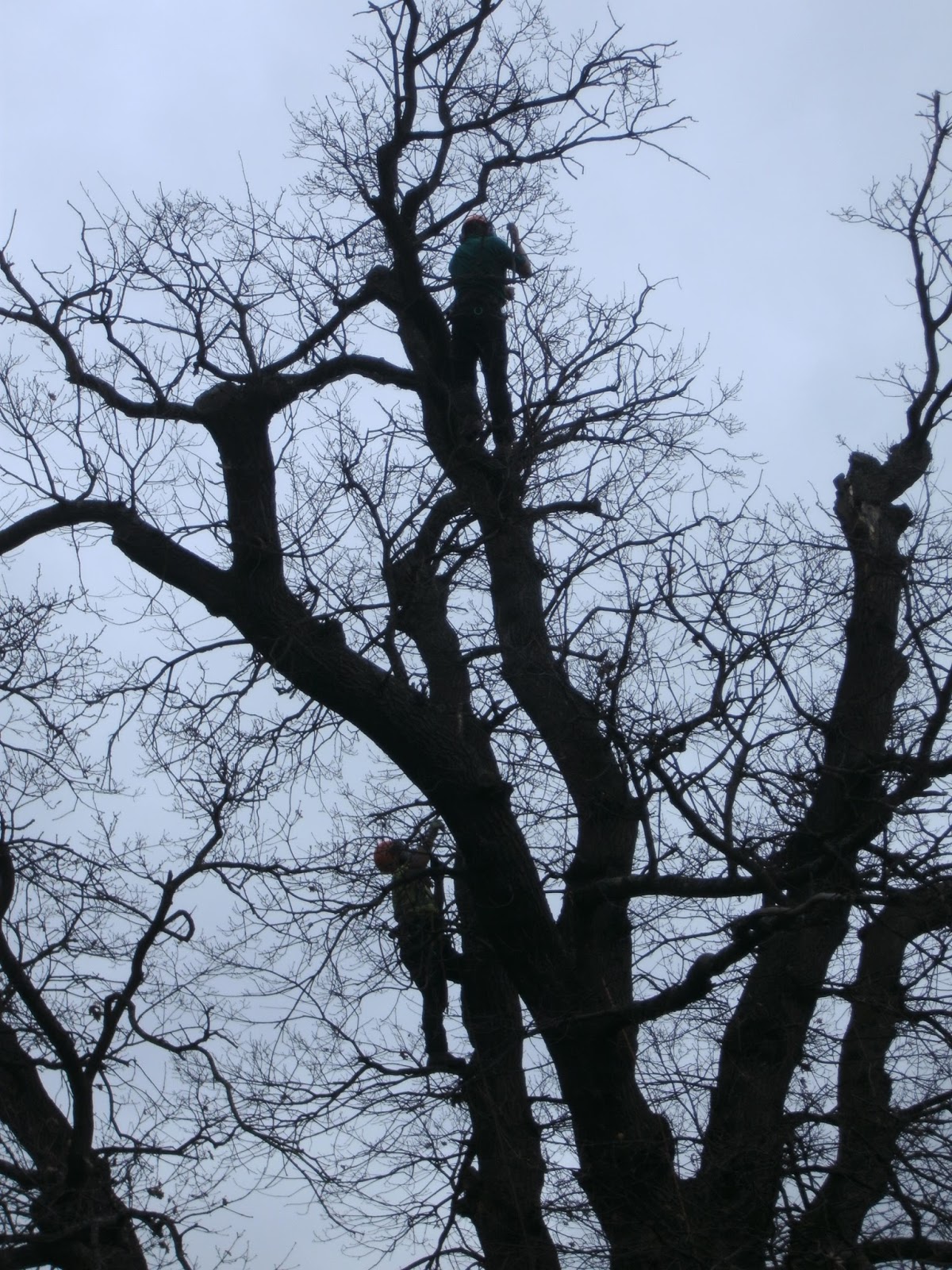
On Tuesday 10th January it had some special visitors. A Glendale arboricultural team from Waltham Forest came to tend to some of its dead and damaged limbs high up in places where normally birds and squirrels go. They were also reducing the height of the crown
Suitably harnessed, two of the guys climbed right up to the top.
For anyone who likes tree climbing, what a great activity. Watching them was exciting.
First they surveyed the tree:
surveying the situation
Then two of them climbed up. They looked like giant wood peckers silhouetted against the sky.
Climbing high


Meanwhile the guys on the ground were watchful to see that members of the public kept their distance and to ensure their colleagues high above were safe. Most of the pruned timber was shredded.
Shredding the prunings
Such skilled work by the arboricultural team.
Hopefully this ancient oak will thrive for a good few more years.

Tuesday, 9 August 2016

Old oak falls July 2016

A member of  Friends of Mayow Park Facebook group posted a message on Friday 22nd July with sad photos about a mature oak tree . One of its major trunks had split and fallen from the main tree. From other comments on that thread, it seems likely that the tree had unexpectedly fallen the evening before around 7.30 pm. Being later in the evening, the park was not busy and luckily no-one was hurt as the tree is near the path that goes past the older children’s play area.
Our Facebook group is very effective at reporting positive or negative happenings in the park which helps to spread the word quickly. The damaged tree was reported to Glendale Lewisham via email the evening of the day it was posted on Facebook. The fallen section looked unsteady but it seemed unlikely that anything would happen on a Friday evening after office hours . 

These photos were taken on the Friday afternoon: 

How good to find out  that first thing the following morning Glendale staff came and draped striped tape around the tree so that people would keep their distance. No tree surgery could take place at that time. Any major works and tree surgery have to be approved by Lewisham’s arboricultural officer and skilled tree surgeons need to be called out so I did not expect much action for days.

TREE SURGERY ONE WEEK LATER
On Friday 28th July an arboricultural team from Glendale Arboricultural Services arrived to work on the fallen oak. The team, wearing harnesses and hard hats, skillfully cut up the trunk that had split from the main trunk. They had to cut most of the remaining standing trunk too, as it  was leaning to one side and could become dangerous. 


One of the guys explained that they were aiming to leave much of the main trunk as a 'monolith' i.e. a dead tree left to decay in a standing position to allow it to support a wide range of species that are dependent on decaying wood.
Woodland management can include a standing dead tree. The team made the tree safe by reducing its height . The hope is that the tree will continue to support a variety of animal and plant species that rely on dead wood including fungi, invertebrates, small mammals and birds. As we saw, the team also left some logs close to the tree to encourage invertebrates.
Signs of hope? A young branch still lives on this monolith tree.
The arboricultural contractors showed great care for the tree as well as safety for themselves and park users. As a Friends group we care about creating a range of habitats for the wildlife of the park so we wait to see if the tree will survive, like its near neighbour the 'lightning tree' oak about 20 metres away. Look carefully at the first of these two monolith photos and you should see a small living branch . . . a sign of hope that the tree may survive.

We don’t know the age of the tree but it is likely to have been over 200 years old. Whether is partially grows back or whether it will die, the tree will continue to serve a purpose in the park.  

Friday, 22 July 2016

June 2016 Mayow Park tree walk part 2

A month ago I started writing  about the Friends of Mayow Park family-friendly tree walk, which took place on 5th June and which included measuring tree height, tree girth and bark rubbings of a few trees.
I'll now try to complete that post
We moved on from the row of silver birch trees, past the former bowls green. Immediately on the right is a good example of an ancient oak that has been pollarded. Trees with a number of trunks above head height are called pollards.  Pollarding involves cutting branches off to encourage growth of new trunks above head height and was a common form of woodland management. The cuts, and therefore new shoot growth, were above the reach of grazing livestock belonging to commoners. This particular pollard had four trunks at about 10 feet high but one had to be removed around 5 or 6 years ago for safety. Seen below is the same tree from different sides. It has three trunks although you can only see two in the photos.

Pollarded ancient oak between bowls green and tennis courts
Mike, with help from some children, measured the girth of this pollard at 5.2 metres, which we estimated as around 300 years old.


hornbeam seed pods

Bark rubbing of hornbeam
Our next stop was the hornbeam. Although hornbeams are indicator trees for ancient woodland, this is a young tree that would have been intentionally planted.
hornbeam leaves


 Hornbeam leaves and seed pods are quite distinctive.
the beautiful hornbeam opposite the orchard

 Before moving on we looked briefly at the orchard, opposite the tennis courts. The orchard now contains 18 fruit trees, all heritage varieties, which were planted in 2012 and 2016 with the support of the Urban Orchard Project.
Mayow Park Community Orchard
Our next stop was the number 1 favourite tree in the park for many children . . . the climbing tree. Quercus Ilex or holm oak is easy to spot, not far from the Recreation Road gates. It is an evergreen oak that sheds its leaves throughout the year and casts such a shadow around it that no plants grow underneath. I recently met an adult in his forties who, as a child, loved climbing that tree. So it has really stood the test of time.

the best climbing tree in the whole park
Heading back across the park we briefly stopped by a row of oaks that clearly look like they were intentionally planted as boundary oaks, to mark field or property boundaries.
Boundary oaks in Mayow Park early spring 2016
We headed across the oval field to the tree we think must be the oldest oak in the park. It stands near the fountain and is another pollard. Its girth was 5.4 metres,  measured at a height of 1.3 metres from the ground. Could this tree really be around 340 years old? I'd welcome measurements of other oaks and age calculations from other people.
within sight of Victorian fountain
girth 5.4 metres
Could this be the oldest tree in the park?