Showing posts with label wildlife in Mayow Park. Show all posts

Friday, 27 September 2019

Autumn in Mayow Park

27th September 2019 and the park is moving into autumn. Today was sometimes sunny and warm and sometimes heavy showers. Our park photographer Ron Packham has been out in Mayow Park to see what is stirring. Here are two of his photos.

Collecting food to store
The squirrels have been very busy during the last couple of weeks. Ron has caught on camera how these animals collect conkers in readiness for winter. They dig holes to bury their horde but often seem to forget where they buried their larder


Dappled light after rain, looking towards the tennis courts
This lovely photo taken by Ron looks like an autumn painting with its dappled shades of green and brown. The view is looking east towards the tennis courts along the path from Recreation Road.

Sunday, 16 April 2017

LOOKING FOR BATS IN THE NIGHT

The evening was perfect for a bat walk; mild with only a gentle breeze and plenty of flying insects in the moonlit dusk. Friends of Mayow Park had arranged another visit by bat expert Dr Iain Boulton to lead this popular event.
Tree silhouette against moonlit sky
Photo: V Hero
The date was 31st March 2017, with a bright new moon, a clear sky and trees silhouetted against distant lights. In urban London  it never gets completely dark at night.  Around 70 people (including 17 children) gathered in Mayow Park hoping to see and hear bats.

Iain (out of sight) gives brief intro to bats
photo:V Hero
Dr Iain Boulton ( he answers to Iain) explained some facts about bats and how they use eco-location to locate and catch their prey. He brought along his bat detectors and explained how to use them before leading us along the path from the cafe to Recreation Road.
Heading off to find bats
Photo: V Hero
Children shone their torches or held the bat detectors pointing towards the tree tops. The park looked like a fairy-tale land, very magical. We saw very few bats and those we saw or heard were near the Recreation Road gate. 
It is quite early in the season so we can all keep an eye out at dust in the park over the coming months to see bats.
Iain has offered to lead another walk in September when we may see more of these wonderful flying mammals.

Next time we could try a circular route round the park as there are wooded areas right round the park including behind the trim trail and older children's space.

End of walk and about to leave the park
Photo: V Hero

Monday, 19 September 2016

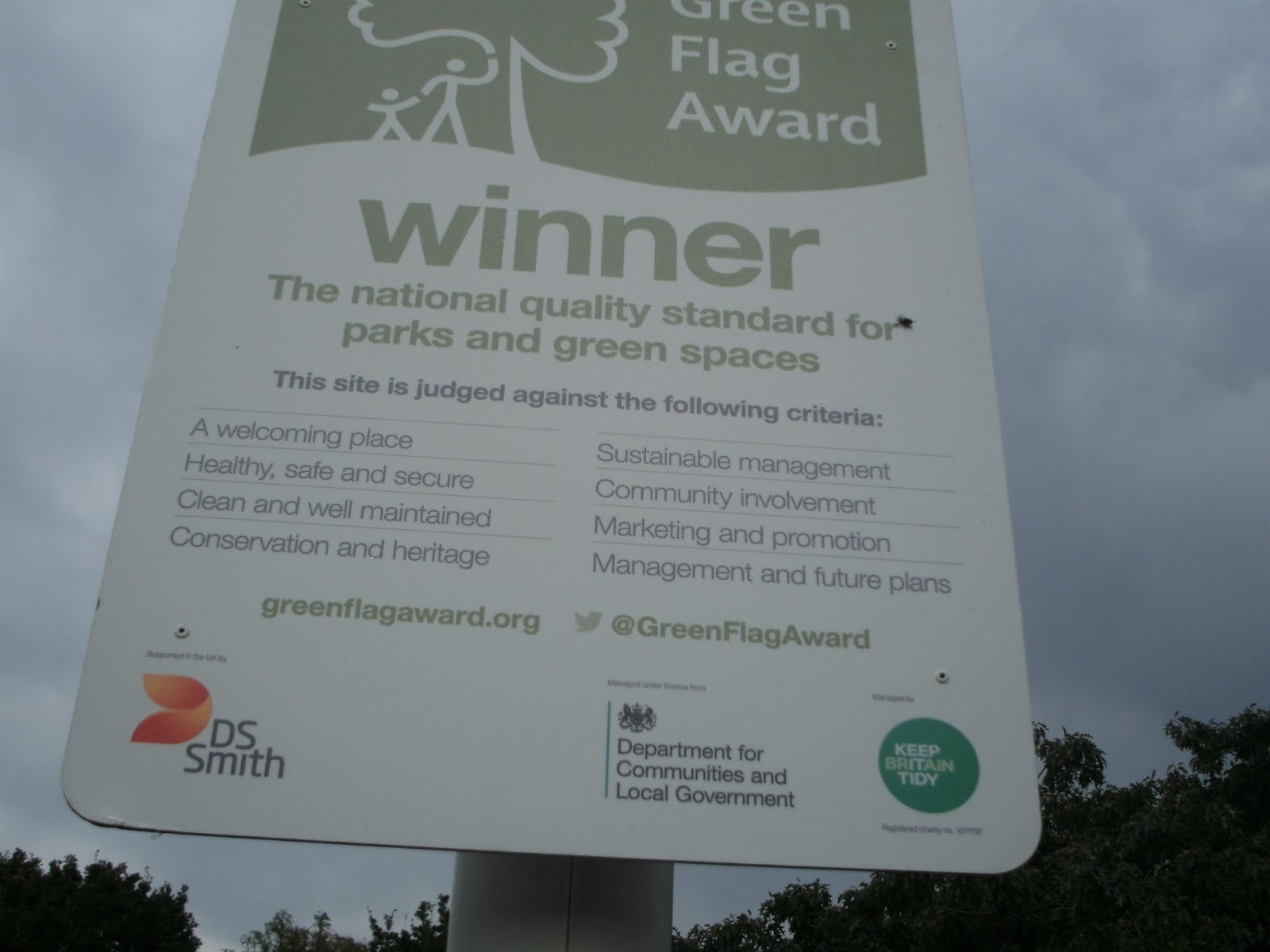
Green Flag raised 19 September 2016

We learned back in July that Mayow Park was one of a number of Lewisham parks awarded another Green Flag. The judges  visited a few months earlier, inspected the park, spoke to park users as well as Glendale and Lewisham officers. They had to judge against the following criteria:


  • A welcoming place
  • Healthy, safe and secure
  • Clean and well maintained
  • Conservation and heritage
  • Sustainable management
  • Community involvement
  • Marketing and promotion
  • Management and future plans
Thinking about those criteria, the onus is not just on Glendale, the contractors,  to manage the park to a satisfactory level according to their contract with Lewisham Council's Greenscene department but also for them to engage with the community. It is also up to the park-using community to show how we care about the park and are willing to make efforts to make it the friendly place it is. The list of different groups that use the park is long so apologies for missing any group:
  • families with young children
  • people who visit the Cafe 
  • Grow Mayow visitors
  • young people who use the park to meet friends
  • adults using the park for relaxation and socialisation
  • tennis players
  • fitness enthusiasts
  • dog walkers
  • people who choose to walk through the park rather than along roads
  • children's football clubs
  • cricket players
  • wildlife enthusiasts (invertebrates, birds, bats, trees and plants come to mind)

Today, Monday 19th September 2016, was the day the new Green Flag was raised by Glendale officers and staff. Steve, (the maintenance man as he is affectionately known), prepared the new flag and hoisted it, assisted by Chris Thompson and Darren Budden with some of the Friends of Mayow Park  present.

Steve checks the pole is steady
Steve balances on his step ladder to lower the old flag
New flag unfurled 
                                                   Steve carefully attaches new flag    
                                                                                                                                                                   
Chris makes sure the correct flag is being raised
                   
Job done and Steve packs away his step ladder
     Mayow Park  has many regular users who care about the park. Thank you everyone who puts in the effort to make it such a welcoming green space.              

Friday, 16 September 2016

Bat walk on 16th September 2016

The day began with heavy rain and remained damp so there was no certainty the bat walk would go ahead.  Our last bat walk in April was washed out, although everyone enjoyed walking through the park in the rain after dark, so we all wanted to see bats this time. Luckily, by 6 o'clock it was clear the rain clouds were blowing away though the sky remained cloudy.

We met up near the pavilion at 7.15 pm,  had a brief introduction to the bats of Britain, a summary of our route through the park and a reminder of any potential hazards.
The event was led by Dr Iain Boulton.  Iain showed us how to use the bat detectors and off we went.

First stop was the 'balcony' overlooking the bowls green and our bat detectors detected bat activity. As our eyes got used to the dark of the trees and the lighter background of the sky we could see the fast flitting of the bats. Better still was when we moved past the bowls green to the space between the green and the tennis courts. With trees along the back of the Bishopsthorpe gardens behind us, the hedge of the bowls green to our right and a number of older trees around, we saw a number of bat silhouettes sweeping against the night sky. According to the bat detectors, we were watching pipistrelle bats.

Moving on along the path between the orchard and tennis courts we could hear more bat activity and saw some bats flying around above the orchard.

These amazing flying mammals have to work hard now to fatten up before they go into hibernation mode for the winter. And where will they hibernate? The old trees in and around Mayow Park have many hollows and some of these are small enough for bats to roost safely away from disturbance from other tree animals in the park. some of the houses nearby may also provide a suitable habitat under the roof tiles.

Reviewing the evening, Iain guessed that we saw around 5 or 6 pipistrelle bats but it would have seemed more because they swirled to and fro.
There were 27 people in total including 7 younger children.
Iain is looking forward to 2017 and has promised another walk next spring. Thank you Iain for helping us to appreciate some of the wildlife of Mayow Park.

Monday, 29 August 2016

A bat walk for September 2016

There was a bat walk on 2nd April 2016 led by Dr Iain Boulton. It was popular and drew a good crowd of adults and children BUT the steady rain persisted so the bats stayed away. Despite that most people said they enjoyed their time in the park after dark. Bats have been seen flying in the park near the bowls green at dusk so we know they are out there.
After the event, Dr Boulton said he would be willing to lead another walk so . . . we plan to try again on 16th September, from 7.15 pm to 8.30 pm. As before, we will meet by the Mayow Park cafe, close to the main entrance in Mayow Road.

Saturday, 16 April 2016

Wildlife at our workday 16th April 2016

Friends of Mayow Park organised a gardening session at the Pavilion Triangle beds, not knowing who or what might join us. Two of us had just arrived and were standing by the holly tree when down flew a gold crest. The bird then hovered at the tree ( a bit like a humming bird) and few back into the conifers by our compost bins. Jon had seen the bird and its markings very clearly but was not quick enough to get a photo.
<https://www.rspb.org.uk/discoverandenjoynature/discoverandlearn/birdguide/name/g/goldcrest/>


Over the next two hours people made other discoveries: a centipede and a frog in particular. The following photos are from Carol Robinson (CR) and Lumen Silveira (LS)
(CR) what have we found?


(CR) looks like a frog
(LS) Frog taken to a place of safety


After the gold crest and the frog, would we something else? We found a centipede scuttling out the way  of people busy with weeding and planting. 


(AS) Grow Wild wild flower seed pack
(CR) sowing wild flower seeds in our mini meadow
                                                                   
(AS) wild flower mini meadow
More photos and a summary of our Big Dig will be in  the next blog. 

Monday, 4 April 2016

50 attendees on bat walk April 2016

The planned bat walk on Saturday 2nd April 2016 generated a great deal of interest in emails to Friends of Mayow Park and to our Facebook group. Saturday was a mild day, sunny and relatively warm.
Although the weather forecasters predicted rain starting after 7.30 pm it felt as if they were likely to be wrong. . . Unfortunately the forecast was correct.

Fifty people, some with umbrellas, met in the park at 7.45 pm, including twelve children. Dr Iain Boulton, who was leading the walk, gave a brief introduction about bats and about using the bat detectors. He reminded us to use the detectors in a way similar to a torch, pointing at the trees rather than vertically up into the air. Iain gave out the detectors, one per group of people, and we moved off.

We walked through the park, along the path on the southern side, near the Bishopsthorpe Road houses. With plenty of bushes and trees along that path, if the bats were out that would be the place we might pick up their sound on the detectors.

At the holm oak tree, near Recreation Road, we stopped and waited, then returned slowly towards the cafe. Some people walked into the meadow where tall shrubs and trees create a boundary with Mayow Road. Sadly no bats there either, although one young person was certain he spotted one bat.

It had been a great turnout of people and many enjoyed being able to stroll through the park after dark. One boy and his mother went looking at trees in the bushes and found a large toad, which was a thrilling discovery and one which he would remember for a long time.
All the bat detectors were returned and Iain offered to lead another walk, this time in September.  So look out for publicity nearer the time.

Sunday, 27 March 2016

Look out for stag beetles in Mayow Park from May to July

With summer approaching, I am keeping an eye out to protect stag beetles and their larvae in Mayow Park. In May, June and July stag beetles will start to emerge from decaying wood under the ground where they have been tunnelling through as larvae.

Mayow Park has been a hotspot for these magnificent creatures but numbers have declined in recent years through a number of factors including damage to their habitat, being dug up by predators, caught by cats and crushed by cars on our roads. They are clumsy flyers and end up falling to the ground. 
Male stag beetle (lucanus cervus) from London Wildlife Trust
London wildlife Trust has an advice note about stag beetles (lucanus cervus)

These creatures are detrivores, eating their way through decaying wood and helping to create new soil. The larvae bore through decaying wood  underground for up to seven years before changing into the stag beetles that we all recognise. You can tell them from similar looking larvae: lesser stag beetle larvae feed on decaying wood above ground and cockchafer larvae live on living roots.

The PTES charity has produced an ID guide to different, but similar-looking larvae http://ptes.org/wp-content/uploads/2014/06/Larvae-ID.pdf


stag beetle larvae in their characteristic curled pose https://ptes.org/campaigns/stag-beetles/
The female stag beetle looks similar to the lesser stag beetle (dorcus  parallelipipedus)   http://www.wildlifetrusts.org/species/lesser-stag-beetle as they both have pincer-like jaws that can nip your finger. Significantly it is all black where lucanus cervas is a dark-brown/ black.  Dorcus is far more widespread and can be found across England and Wales.
Stag beetles  are protected in the UK under the Wildlife and Countryside Act 1981. They are classified as a priority species in the UK Biodiversity Action Plan.

Here a summary of  information from London Wildlife Trust

 How to spot a stag beetle 
·         You are most likely to find a stag beetle near or on dead wood
·         It's between 5cm and 8cm long
·         It's got large antler shaped jaws
a)     The male's jaws are very large
b)    The female's jaws are smaller but more powerful
·         Adults emerge from the soil beneath logs or tree stumps from mid-May til late July
·         Males are often seen flying on sultry summer evenings an hour or two before dusk

So let's all be aware of these special invertebrates and help them to thrive once more in Mayow Park.

Wednesday, 16 March 2016

Bat Walk 2nd April 2016


We don't know if there are bats in Mayow Park but the old oaks have plenty of potential bat roosts. Join us to find out. Do let us know if you hope to be there; it will  help the walk leader manage the sharing out of bat monitoring equipment.