Showing posts with label bat detectors. Show all posts

Monday, 21 April 2025

11th April Bat walk

 We were lucky as the bat walk took place on a warm, dry evening,  a perfect night for bats to hunt and feed on flying insects. We had hopes of seeing bats and we were not disappointed.

We had permission to take people around Mayow Park starting at dusk and the gates were kept open till the walk finished.

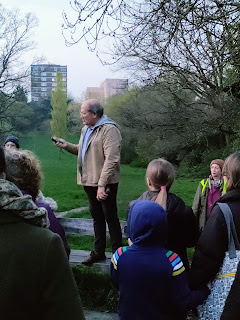
Iain Boulton, our bat expert, gave an introduction about bats in general, about bats in the UK and pipistrelle bats in Mayow Park specifically. 

One of the FOMP committee had drawn a diagram showing how bats have 5 fingers, the thumb at the top and four that connect to their wings. Bats are the only mammal that can truly fly.

Iain showed how to use a bat detector to 'hear' pipistrelles, our local bats. He explained that to 'hear' bats we tune the bat detector to the best listening frequency for the type of bat. For common pipistrelles we set the detector to around 50kHz

Most of the visitors didn't have a bat detector but Iain brought some to lend out. 

It wasn't long before we heard the bats (using the detectors) and saw them flying around catching  insects in the air. The moon looked down on us through the trees.


It was a wonderful evening. 
As people left to go home, many gave us donations and we were able to donate £37 to the Bat Conservation Trust.
All photos; A Sheridan

Sunday, 8 September 2024

Bat walk 6th September 2024

Friends of Mayow Park (FOMP) have learned over the years to limit our publicity for our bat walks.  so we can limit numbers up to a maximum of 50 people. We put posters on the four gates into Mayow Park and send an email to our mailing list. No social media publicity needed.

For our recent bat walk, we closed our bookings at 50 but we could easily have had many more. Maybe we should hold a extra bat walks in future - even if our expert 'bat man' can't lead them?

The weather on 6th September was true to forecast - rain and more rain. Bats don't like heavy rain! But it was warm so there should be plenty of flying insects for them to eat! Fortunately around 7.30 pm the rain stopped, just in time.

Iain introduced the walk with his usual humorous descriptions of bats, their behaviour and the echolocation sounds they make to help them navigate towards their food.
Iain explains bat habits and behaviour 

Iain lent out his bat detectors to groups of people and explained how to use them. First turn on the device, then set it to a frequency of around 50 kHz which would tune in to the sound of the local pipistrelle bats. When they are nearby we should hear a sound similar to a sloppy wet kiss - that's the sound of the bats. Look out for their fast and erratic flight, changing direction very quickly 

Quite a few children came on the walk, with torches at the ready and very good at handling their bat detectors. What delighted excitement when they heard AND saw the bats. 
Despite the light drizzle, there were plenty of insects to feed these amazing flying mammals. It was a magical evening.


Our participants were very generous with cash donations to Friends of Mayow Park and we raised £60 which will be split between FOMP and the Bat Conservation Trust:  https://www.bats.org.uk

Saturday, 22 April 2023

BATS IN THE NIGHT 21 April 2023

Outdoor events can cause weather worries for organisers, commonly ‘will the weather force us to cancel?’.

But a bat walk must factor in the needs of bats too; they are not keen on inclement weather. They prefer mild, still evenings with plenty of flying insects for supper.

Friday 21st April began very wet and cold. Should we cancel the event? 

The BBC and the Met Office offered assurances for brighter weather by the late afternoon. And that is how it turned out.

The weather improved rapidly. By 8pm when people started to gather at Mayow Park, it was a still evening with clear sky, full of flying treats for bats. 

The meeting point

Iain's intro

     Using a bat detector

Dr Iain Boulton opened the event with some entertaining batty facts. He certainly knows his bats. He brought some bat detectors to lend out to walk attendees, showing us how to set them to around 50 kHz, the frequency for the pipistrelle bats we would hear or see in Mayow Park. The detectors, not much bigger than a mobile phone, catch the sounds made by bats flying above our heads and translate those sounds at a level that humans can hear.

Even before we started the walk, at least one bat was detected between the pavilion and guardian oak tree which stands majestically at the park gates.

Walking slowly in the park, first in half-light then dusk, with the trees standing as silhouettes against the fading light, children moving with torches, an occasional bird flying past and all the time listening for the bats: this is a magical, calming sensation.

                                                                on the walk

The pipistrelles flew out for us at three locations along the south side of the park, along the path between Mayow Road an Recreation Road, while Venus shone down on us from high in the night sky.

A lovely evening. Thank you to all who joined us and to Iain for leading us.

TOTAL ATTENDING 52 + walk leader

36 adults + 12 children + 4 volunteers + Dr Iain Boulton, our walk leader

All photos courtesy of Pippa Moss