Showing posts with label tree surgery. Show all posts

Tuesday, 20 January 2026

MAYOW PARK FOR WILDLIFE IN 2025

Mayow Park is a site of importance for nature conservation within the borough of Lewisham. The Friends of Mayow Park take that responsibility seriously in their activities.  

ORCHARD: During 2025 the  Friends held orchard pruning workshops, volunteers removed unwanted grasses round those trees and planted bulbs which should produce a floral display this year. Fruit blossom on the trees attracted bumble bees and other pollinating insects. Ladybirds were busy eating aphids. Lady’s Smock (a small delicate flower) made its annual appearance in late March. The orchard trees produced many fruits with some left on the ground for wildlife.  We worked with Glendale in autumn to cut back scrub (mainly brambles and ivy) behind the orchard to allow grass to grow – grassland is an important habitat for invertebrates.

POND: Built with help from Froglife, The Orchard Project and local volunteers, the pond was first constructed with a liner in March 2025 but later in the summer it was re-shaped as a natural clay pond surrounded by a wildlife friendly dead hedge. Over time we hope it will attract dragonflies, frogs and other creatures. Nearby we have created a bee bank for wildflowers to attract pollinators and we would be so happy to see many different types of butterfly.

ANIMALS: We held two evening bat walks in 2025 –enjoyable for all ages. We regularly see crows and magpies, sometimes jays, hear the occasional woodpecker. Common birds include robins, blue and great tits and many parakeets. We have been lucky in recent months to watch the activities of a pair of Egyptian geese that have visited us from time to time.

TREES: With many old and veteran trees, over time their limbs die and they can present potential hazards to the public.  During the past year (2025) tree surgeons cut down dead trees and removed heavy limbs from other trees with safety a priority. Trunks were left lying on the grass for park visitors to use as additional seating and as habitats for insects and fungi. Do visit and look at the different fungi that grow on dead wood. Can you name any?

Before surgery


After surgery Nov 2025

IN OTHER NEWS: Friends of Mayow Park (FOMP) have a new Chair. At the recent Annual General Meeting,  (January 2026) the Friends elected Robert Hero as Chair. We are delighted. Robert has a keen interest in the park and  knows many park users. He cares about the wildlife, the upkeep of the park and the way that humans treat the park. He is an animal lover and walks his dogs in the park almost daily.  He and the FOMP committee will plan for activities to make the park the best it can be, working closely with Glendale, the company that manages the park for Lewisham.  Robert intends to reach out to more park users and encourage them to join us so that FOMP will become a strong and influential park user group.

And to finish off, here is a fungus beauty on an oak log on 20th Jan 2026

warty jelly fungus (Exidia glandulosa)


Saturday, 15 September 2018

Tree bracket

In June this year a young(ish) red horse chestnut in Mayow Park was observed and identified as  dead with only a  few dried leaves remaining, no leaf buds and brittle branches, perhaps due to the challenging weather last winter (extra cold), spring (extra damp) and summer (extra dry). Lewisham's tree officer arranged for tree surgeons to remove all branches. The tree was able to remain as a monolith, standing proudly, providing habitats for fungi and invertebrates.


monolith red horse chestnut: photo A Sheridan
By the end of August a magnificent Dryad's Saddle bracket fungus (Polyporus squamosus) had taken up residence roughly 2 metres above the ground.

Underside Dryad's Saddle (photo A Sheridan)

Dryad's Saddle view from above  (photo A Sheridan)
This fungus is supposed to smell strongly of water melon but it was too high up to find out. It does not have gills but has pores instead. Its chosen habitat is deciduous trees and stumps. It is a fine looking fungus.

Tuesday, 27 June 2017

TREE LOSES LIMB May 2017

Mayow Park has an impressive number of pollarded boundary oaks, planted between 250 and 300 years ago to mark field boundaries, before the existence of the public park we know today.
Boundary oaks indicate a once common farming practice to mark land and field boundaries in the same way as walls and fences.

Pollarding is a pruning method used for centuries to manage trees. The upper branches are removed when the tree is still young and in the case of these ancient boundary oaks they develop new upward-growing branches which over the centuries become as thick as mature trees and look like respectable tree trunks in their own right.
 Daniel Greenwood (from Sydenham Hill Wood, a stone’s throw from our park) has written about boundary and pollard oaks in nearby areas and you can read his fascinating article about some of the trees here:  https://danieljamesgreenwood.com/tag/boundary-oak-trees/
 So Mayow’s ancient oaks reflect past local land management, while providing habitats for a large number of flora and fauna today. Birds, small mammals and invertebrates make their homes in the hollows, fungi and mosses find somewhere to grow. The trees contribute to the character of the park and park users have often said that the Mayow trees are valued in making the park landscape so special.
When a lovely tree that has stood for centuries loses a major limb many of us express sadness, as happened to a pollarded oak in Mayow Park on 19th May 2017. A local resident posted a photo to Friends of  Mayow Park Facebook group, thus alerting park users and the park maintenance team.

Tree alert. Photo by K Andreakou
The tree that lost a limb had the widest girth of any of the ancient trees in the park as measured on a tree walk in 2016.  Word quickly spread. Soon adults and children were seen clambering over the fallen limb and around its broad branches,  enjoying the opportunity to get close and personal.   A tree that probably few had noticed became a celebrity overnight. It was lovely to see how people engaged with the tree. But current concerns about health and safety, with the risk of someone falling and injuring themselves, was too great. Something had to be done.                                                                                                            
Clambering around a fallen tree
Heavy branches of the fallen limb hidden by dense foliage           
                                
Within a week a team of arboriculturalists from Sevenoaks arrived to make the broken limb ‘safe’. 
photo K Andreakou
Photo K Andreakou
Photo K Andreakou
These guys are clearly skilled at their job.  They explained their intention to leave most of the thicker branches on the ground to create wildlife habitats. Some of the thinner branches were taken to use as path edge markers along the woodchip path adjacent to the dawn redwood tree. Other branches were relocated by volunteers from Friends of  Mayow Park into a locked woodland nature area for wildlife, out of reach of human interference. And the thinner branches were shredded.


Broken limb still attached to parent tree by a small fragment of wood and bark

Concerns were raised by park users: maybe this tree is diseased because the heartwood of the broken limb was powdery brown sawdust? 

Powdery hollow heartwood


Without scientific knowledge about ancient oaks, I am inclined to the view that the collapsed limb may be due to old age, to the natural hollowing out of the inner trunk and to being a pollard with heavy limbs that lean out from the tree. I hope someone with greater knowledge can come forward to suggest some reasons for this fail. Meanwhile, the exposed inner core can provide a home to solitary bees, beetles and other invertebrates while the tree continues to live.
Looking around at other ancient oaks in Mayow Park, regular park users will recall that in July last year a mature oak split in two and needed urgent surgery. It now stands as a monolith tree where the whole crown was removed. Tree surgeons pruned it to remain standing as a monolith tree, allowing natural decay processes to continue for wildlife. Remarkably, it survives and has started producing new growth with side branches.
Not far from the monolith tree is the ‘lightning tree’. Hit by lightning a few decades ago, it lost most of its crown, thus exposing its hollow interior. It continues to survive, with growth only on one side of the trunk. 

These individual ancient trees contribute to the value of the park. Regular visitors recognise them, plants and animals colonise them and they recall land management history as pollarded and boundary oaks. 

(Photos by K Andreakou and A Sheridan)

Thursday, 12 January 2017

Pollard oak gets a trim

There is a large pollarded oak tree between the tennis courts and the bowls green.
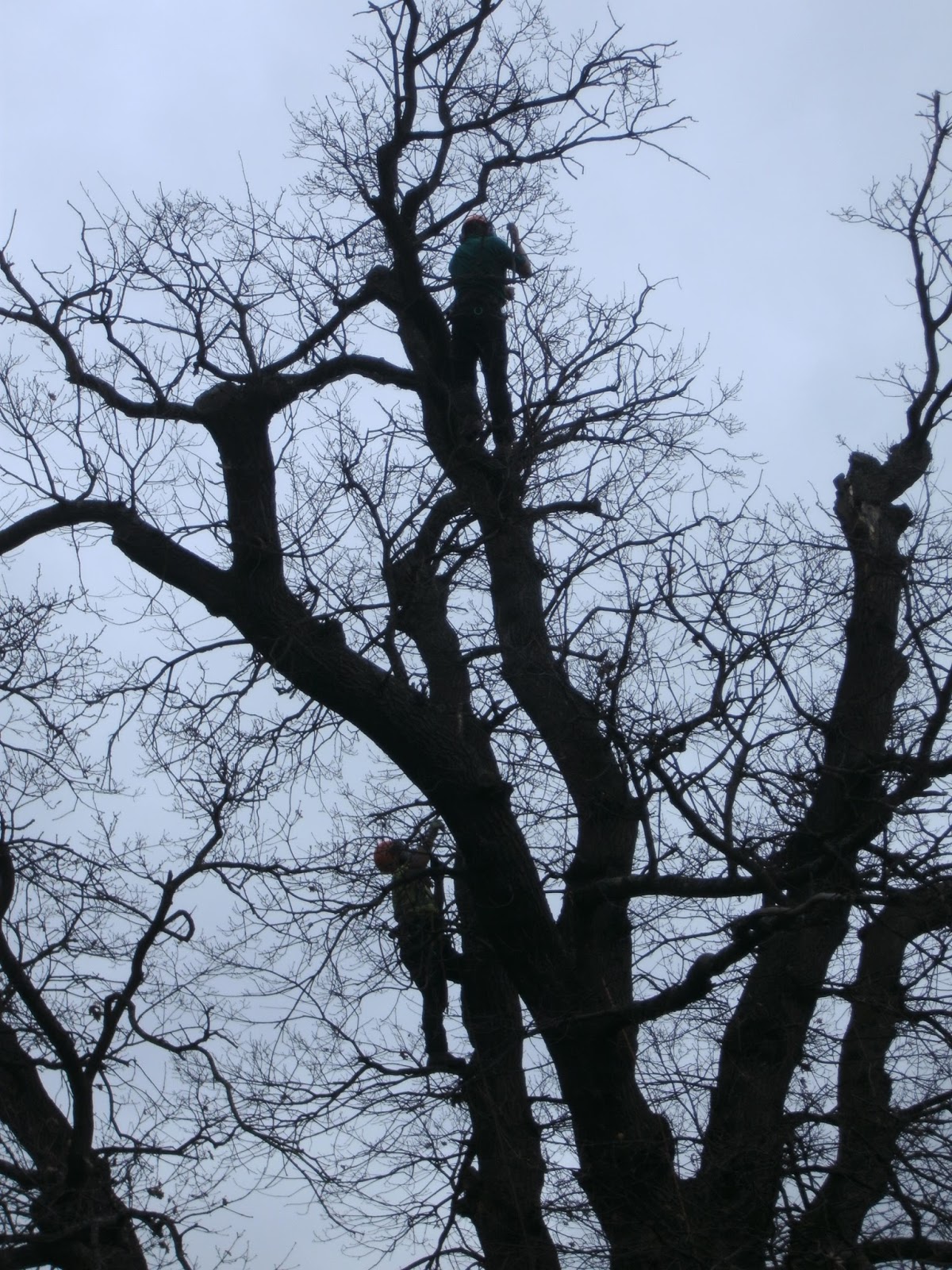
On Tuesday 10th January it had some special visitors. A Glendale arboricultural team from Waltham Forest came to tend to some of its dead and damaged limbs high up in places where normally birds and squirrels go. They were also reducing the height of the crown
Suitably harnessed, two of the guys climbed right up to the top.
For anyone who likes tree climbing, what a great activity. Watching them was exciting.
First they surveyed the tree:
surveying the situation
Then two of them climbed up. They looked like giant wood peckers silhouetted against the sky.
Climbing high


Meanwhile the guys on the ground were watchful to see that members of the public kept their distance and to ensure their colleagues high above were safe. Most of the pruned timber was shredded.
Shredding the prunings
Such skilled work by the arboricultural team.
Hopefully this ancient oak will thrive for a good few more years.