Showing posts with label pests & diseases. Show all posts

Friday, 22 May 2026

summer volunteering in our orchard

 18th May 2026, will it rain or won't it? 

The weather forecast seemed unpromising, cloudy and rain likely in the morning. But the orchard trees were looking forward to a bit of TLC and we didn’t want to disappoint.

Eight volunteers arrived, ready to check tree health, to look for pests and diseases.

We looked for apple ermine moth caterpillars chomping away in curled leaves covered by their webbing. The webs protect them against any would-be predators looking for a meal of their own. We didn’t find any but will keep looking.

We looked for powdery mildew and found plenty. 

The volunteers will prune these and dispose of diseased leaves carefully, away from the trees, and clean the pruning tools to avoid spreading the disease.


photo A. Sheridan: powdery mildew

One volunteer spotted what looked like a small fluffy ball – a sign of woolly aphids. These are sap-sucking insects, hiding in cracks in bark or in old pruning cuts. When anyone picks at the fluffy featheriness you will find inside small purplish aphids.

Photo A. Sheridan: woolly aphid


Some trees showed signs of pests mainly at the top of the crown, with many leaves looking ragged due to holes and brown/ black spots round the edges. 
Two possibilities for this:
  • Either caterpillars like Apple Ermine moth munching the leaves 
  • Or Apple Scab which is a fungal disease. 
We’ll keep an eye on this. No photos as the leaves were too high in the crown.

While looking we also found lichen. Don't worry, lichen doesn't harm the trees. It is said that lichen is an indicator of good air quality. 

Photo A. Sheridan: lichen on apple tree

Tuesday, 28 February 2023

Orchard winter pruning workshop

Organised and facilitated by members of our own Friends of Mayow Park (FOMP) group, we ran two workshops  in Mayow Park's community orchard (near the tennis courts) on 24th and 28th February 2023.  
Five people attended session one and six attended session two - eleven people in total.
Both sessions began with a short intro on  tools for pruning and how to look after them. Next came 'getting to know your tree' by looking for damaged, dead and diseased branches on the trees. We talked about  the process of grafting scions, different rootstocks and reasons for mulching.
After the brief theory intro we visited some trees to look carefully at what should be pruned and why.
Then on to the practical pruning, in pairs.   
One of the  FOMP members worked on weeding round the trees and collecting  mulch to lay around each tree.
The two hour sessions did not give us enough time for all the trees but those we worked on seemed very contented after.
Our regular orchard volunteers will continue pruning and mulching over the next two weeks.

Equipment at the ready

choosing which branch to cut


Loppers  being moved to cutting position

A clean cut with sharp loppers

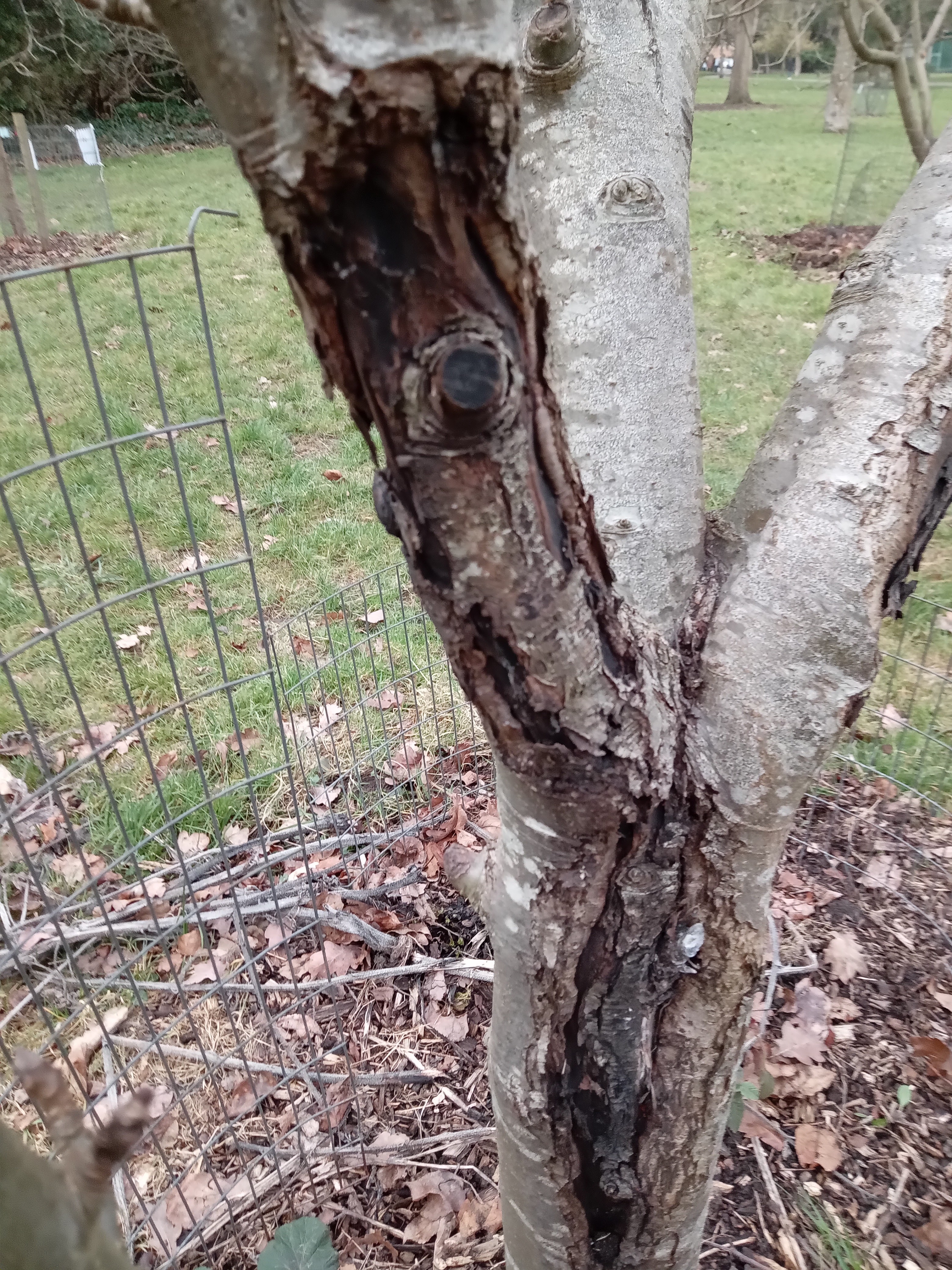
A few trees are not in the best of health. One apple tree has had fungal canker for a few years but seems to be healing some of the wounds this disease caused.
Canker on Crawley Beauty

Unfortunately the Conference pear tree has never thrived. It turns out it has been planted where the ground gets rather water-logged after heavy rain. Now its main trunk is being eaten alive by wood borers.

Any ideas about the creatures causing this damage?

Soon all the fruit trees will have a blanket of wonderful mulch to keep them cosy in winter, cooler in the heat of summer and encourage mycorrhizal fungi that work in symbiosis with the roots of the trees, swapping nutrients and sugars.
cosy comfort of woody mulch