Showing posts with label trees of Mayow Park. Show all posts

Saturday, 15 September 2018

Tree bracket

In June this year a young(ish) red horse chestnut in Mayow Park was observed and identified as  dead with only a  few dried leaves remaining, no leaf buds and brittle branches, perhaps due to the challenging weather last winter (extra cold), spring (extra damp) and summer (extra dry). Lewisham's tree officer arranged for tree surgeons to remove all branches. The tree was able to remain as a monolith, standing proudly, providing habitats for fungi and invertebrates.


monolith red horse chestnut: photo A Sheridan
By the end of August a magnificent Dryad's Saddle bracket fungus (Polyporus squamosus) had taken up residence roughly 2 metres above the ground.

Underside Dryad's Saddle (photo A Sheridan)

Dryad's Saddle view from above  (photo A Sheridan)
This fungus is supposed to smell strongly of water melon but it was too high up to find out. It does not have gills but has pores instead. Its chosen habitat is deciduous trees and stumps. It is a fine looking fungus.

Saturday, 5 May 2018

A tree for Hilary 4th May 2018

Many locals who have lived in Sydenham for a while will remember Dr Graver with fondness (also known as Mrs Hilary Jarrett). She was highly respected in the community.
She was a very active Friend of Mayow Park. She had been treasurer and Chair of the group, a great advocate of the park in the local community and with Lewisham Council.
Among her MANY achievements she
- helped to start our annual Tree Dressing tradition (held on the first weekend in December),
- was involved in planting a larch and a gingko tree,
-  organised the 125 year celebrations for Mayow Park with her husband John and other volunteers,
- worked tirelessly to get a modern drinking water fountain installed,
- helped to create the fruit and herb triangle beds in front of the cafe,
- contributed a tree to the orchard: Lane's Prince Albert cooking apple.

Hilary died in 2016 and has been very much missed by the Friends group.
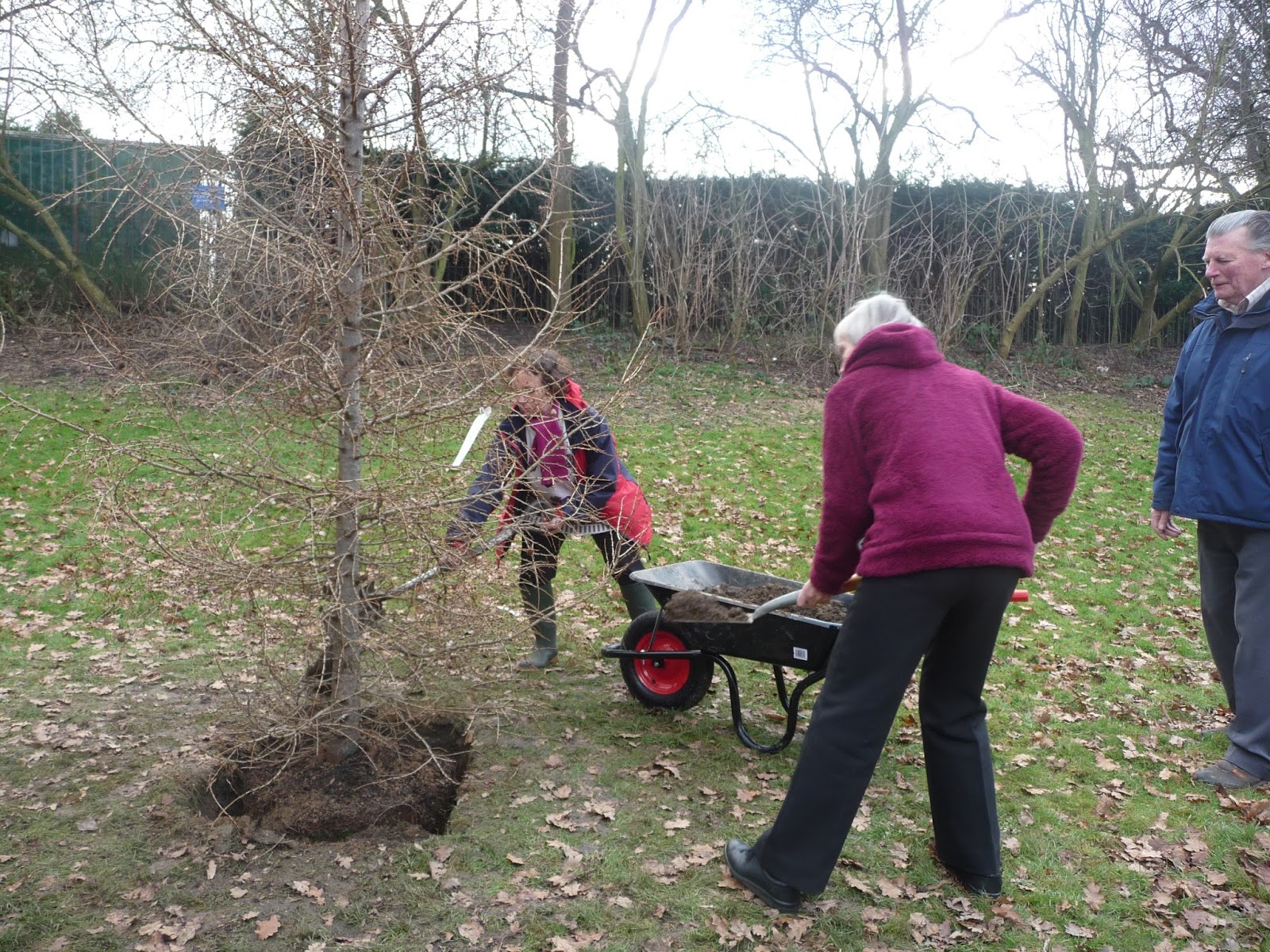
Her family planted a commemorative tree on 4th May 2018 and installed a plaque in her memory. The tree, a larch, is located between the orchard and the Recreation Road entrance.
Many thanks to Lewisham Greenscene and to Glendale for supporting this planting and agreeing the location for this tree.
I would like to thank her family for this lovely addition to the park.


Saturday, 9 December 2017

Celebrating Trees on 2nd December

A year ago, in December 2016, Friends of Mayow Park held our first Tree Dressing Day in the community orchard, an opportunity to celebrate how the orchard has developed with the help of so many volunteers. We had such fun then and the committee wanted to hold the event again this year. We were anxious about the weather but after a light drizzle the rain held off for the rest of the morning.
A team of volunteers gathered at the orchard to put up our gazebo, unfurl our banner, check we had enough fabrics, paper, pens, pencils and crayons, wool, ribbons and string plus apple juice, tea, coffee and hot water. Our story teller, Rich Sylvester, arrived and set up his area under the protective branches of a lime tree.
Rich prepares for story telling

By 10am we were ready to welcome visitors.
Visitors welcomed to our gazebo

But why hold this event? Tree Dressing is based on many old customs from all over the world, celebrated at different times of the year.
Tree Dressing Day in England falls on the first weekend of December every year. It was initiated by the charity Common Ground in 1990 and has grown to become a chance for the whole community to gather and celebrate the leafy friends we all have in common. It is also a chance for communities to reflect on the social and cultural history of their local area, and the role that trees have played in shaping that story. 
Trees have provided our sustenance, food, shelter, medicine and the air we breathe. They are part of our history and also our future. Trees have long been celebrated for their spiritual significance. It can be as simple as tying strips of cloth or yarn to a tree. The practice in Japan is to decorate trees with strips of white paper, or tanzaku, bearing wishes or poetry. 
Borrowing from these many traditions, our Tree Dressing included paper leaves for people to write messages or draw pictures to give to the trees, tie coloured strips of fabric (with or without messages) or make objects to hang in the trees.


Dream catcher


Our story teller captured the imagination of young and old with his stories and showed how to make dream catchers to add to the decorative creativity that was transforming our orchard.


creative decorations

More creative decorations


We finished off the morning with rousing winter songs led by our two wonderful singers Lucy and Valerie, and some mulled wine with thanks to Valerie and Robert.
There are so many thank yous: thank you to all those who visited our event, the lovely children and families who joined in the story telling. Thank you to our story teller Rich. Thank you to all the volunteers who contributed so much of their time. 
Celebrating Tree Dressing in our community orchard was a wonderful way to show our appreciation  of trees in our locality and to share tree stories with everyone who joined us.

Tuesday, 27 June 2017

TREE LOSES LIMB May 2017

Mayow Park has an impressive number of pollarded boundary oaks, planted between 250 and 300 years ago to mark field boundaries, before the existence of the public park we know today.
Boundary oaks indicate a once common farming practice to mark land and field boundaries in the same way as walls and fences.

Pollarding is a pruning method used for centuries to manage trees. The upper branches are removed when the tree is still young and in the case of these ancient boundary oaks they develop new upward-growing branches which over the centuries become as thick as mature trees and look like respectable tree trunks in their own right.
 Daniel Greenwood (from Sydenham Hill Wood, a stone’s throw from our park) has written about boundary and pollard oaks in nearby areas and you can read his fascinating article about some of the trees here:  https://danieljamesgreenwood.com/tag/boundary-oak-trees/
 So Mayow’s ancient oaks reflect past local land management, while providing habitats for a large number of flora and fauna today. Birds, small mammals and invertebrates make their homes in the hollows, fungi and mosses find somewhere to grow. The trees contribute to the character of the park and park users have often said that the Mayow trees are valued in making the park landscape so special.
When a lovely tree that has stood for centuries loses a major limb many of us express sadness, as happened to a pollarded oak in Mayow Park on 19th May 2017. A local resident posted a photo to Friends of  Mayow Park Facebook group, thus alerting park users and the park maintenance team.

Tree alert. Photo by K Andreakou
The tree that lost a limb had the widest girth of any of the ancient trees in the park as measured on a tree walk in 2016.  Word quickly spread. Soon adults and children were seen clambering over the fallen limb and around its broad branches,  enjoying the opportunity to get close and personal.   A tree that probably few had noticed became a celebrity overnight. It was lovely to see how people engaged with the tree. But current concerns about health and safety, with the risk of someone falling and injuring themselves, was too great. Something had to be done.                                                                                                            
Clambering around a fallen tree
Heavy branches of the fallen limb hidden by dense foliage           
                                
Within a week a team of arboriculturalists from Sevenoaks arrived to make the broken limb ‘safe’. 
photo K Andreakou
Photo K Andreakou
Photo K Andreakou
These guys are clearly skilled at their job.  They explained their intention to leave most of the thicker branches on the ground to create wildlife habitats. Some of the thinner branches were taken to use as path edge markers along the woodchip path adjacent to the dawn redwood tree. Other branches were relocated by volunteers from Friends of  Mayow Park into a locked woodland nature area for wildlife, out of reach of human interference. And the thinner branches were shredded.


Broken limb still attached to parent tree by a small fragment of wood and bark

Concerns were raised by park users: maybe this tree is diseased because the heartwood of the broken limb was powdery brown sawdust? 

Powdery hollow heartwood


Without scientific knowledge about ancient oaks, I am inclined to the view that the collapsed limb may be due to old age, to the natural hollowing out of the inner trunk and to being a pollard with heavy limbs that lean out from the tree. I hope someone with greater knowledge can come forward to suggest some reasons for this fail. Meanwhile, the exposed inner core can provide a home to solitary bees, beetles and other invertebrates while the tree continues to live.
Looking around at other ancient oaks in Mayow Park, regular park users will recall that in July last year a mature oak split in two and needed urgent surgery. It now stands as a monolith tree where the whole crown was removed. Tree surgeons pruned it to remain standing as a monolith tree, allowing natural decay processes to continue for wildlife. Remarkably, it survives and has started producing new growth with side branches.
Not far from the monolith tree is the ‘lightning tree’. Hit by lightning a few decades ago, it lost most of its crown, thus exposing its hollow interior. It continues to survive, with growth only on one side of the trunk. 

These individual ancient trees contribute to the value of the park. Regular visitors recognise them, plants and animals colonise them and they recall land management history as pollarded and boundary oaks. 

(Photos by K Andreakou and A Sheridan)

Thursday, 17 November 2016

REMEMBERING HILARY

People who have lived in the locality for some years will remember Dr Hilary Graver, known to others as Mrs Hilary Jarrett. Long-time members of  Friends of Mayow Park (FOMP) have very fond memories of her.
Hilary became actively involved with the Friends of Mayow Park in 1996 when it was still known as Mayow Park Users’ Group and she remained very active until 2014. As Chair of FOMP for 5 years and Treasurer of the group for much longer she steered the group through a time when many parks were in decline, her aim always to ensure that Mayow would be a much-loved and well-used park. She pushed for the name change to Friends of Mayow Park in the late 1990s.
In the early days the Friends of Mayow Park held their quarterly meetings in the homes of members. Hilary knew many people in the community and it was not long before she arranged with the then Head of Forest Hill School toallow FOMP to  meet at his school and for him to participate in our meetings. This arrangement continued until Peter Walsh retired as the school Head.

TREES
She believed in the importance of trees to the environment. In Mayow Park, she cared about the magnificent ancient oak trees, which provide a home for many invertebrates, birds and mammals. She, along with husband John and neighbour Bruce, measured the girth of every oak tree and registered the results with the Woodland Trust.

TREE DRESSING
The custom of tree dressing, which takes place annually on the first weekend in December, was embraced by Hilary as a positive community activity in Mayow Park for a number of years, with one particular oak tree being chosen, its long horizontal branch no more than 8 feet above the ground.
Hilary (on right) at Tree Dressing December 2008  © Heather Mallinder

As well as celebrating the ancient trees of Mayow Park, Hilary was keen to get involved with tree planting. In January 2010 the Friends planted a larch, a deciduous conifer, in recognition of the celebration of Tu B’shevat, the Jewish New Year for trees. Hilary was there, spade at the ready, to make sure the tree was well-planted.
Planting a larch behind the bowls green January 2010 © Emma Tarling 
THE COMMUNITY ORCHARD
The first fruit trees were planted in January  2012. Sponsors were invited to come forward to select heritage varieties to buy. Hilary chose and planted Lane’s Prince Albert apple. It was a variety she knew from her childhood. For the next three years, from spring to autumn, she and John came once a week to deliver 20 litres of water to the roots of the tree, to ensure it would grow strong and healthy. Eleven fruit trees were planted in 2012. Since then the orchard has expanded to eighteen trees.

Lane’s Prince Albert apple tree © A Sheridan
WATER FOUNTAIN
Many people like the ornamental, old Victorian drinking water fountain which is a feature in the park. Long ago it went out of use, its lead pipes filled with concrete and the drinking cups removed. There were some who wanted it restored and Hilary took on the task to find out if this would be feasible. She contacted the Metropolitan Drinking Fountain and Cattle Trough Association to find out if it would be possible to apply for grants to restore it. She met representatives from that Charity and all concluded that it would it would not be possible. Undaunted, Hilary decided that the way forward would be the installation of a new, modern drinking water fountain, as near as possible to the Victorian one. Her communications with the Drinking Fountain Association went back to 2009.


Fountain with new plaque installed 2014 © A Sheridan
Hilary wanted the public to be aware that the fountain was a contribution from the Friends of Mayow Park with a grant from the Drinking Fountain Association so she ordered this plaque which was installed by Fred Baverstock and his colleague,  Steve.

Plaque located behind drinking fountain © A Sheridan


BOWLS CABINS
Another campaign she led comes to mind: the installation of the bowls cabins on the green so that the bowls club could vacate the pavilion which was in urgent need of refurbishment. Hilary was furious that FOMP had not been fully consulted about plans to install shipping containers between the bowls green and tennis courts. Thanks to her negotiations with Lewisham and her local campaigning, the cabins were finally located in their present position, though she always viewed their current location as the lesser of two evils.

GREEN FLAG
Mayow Park was awarded its first Green Flag in 2011in recognition that the park had reached a certain standard of maintenance and that the local community was actively involved in caring for the park.
October 2011 first Green Flag for Mayow Park  © A Sheridan 
STATE OF THE PATHS
The dangerous state of the paths was a serious cause for concern and Hilary campaigned hard for improvements. From time to time paths were temporarily repaired, but this was never enough. The first genuine improvement was the complete resurfacing of the path parallel to the children’s playground. Sadly, Hilary did not live to celebrate the resurfacing of most of the paths, a task completed in Summer 2016.  
New path towards children's playground July 2011 © A Sheridan
PAST MEMBER  REMEMBERS
Emma, a former member of FOMP, moved away from Sydenham a few years ago. She remembers Hilary’s role in Mayow Park. 
"I first became involved with FOMP at the end of 2008 as I was concerned with the state of the children's play area. At that time, the Mayor of London launched a competition to encourage communities to vote for funding to improve a selection of local parks. 
I remember standing outside the Co-op with Hilary on cold winter days speaking to people about the future of Mayow Park and what was desperately needed to encourage more use. This competition created an awareness of our park within our neighbourhood and a steady flow of funding by other schemes and charities followed, giving us the opportunity to make those necessary improvements for the benefit of everybody in the community." 
    
IN THE NEWS
An article in the Newsshopper January 2009 about  this competition quotes Hilary:
"The park has been badly neglected and has been going downhill since the 70s. All it needs is some tender loving care but it needs the money to do this. Most people want the paths improved, the restoration of the pavilion, and a park keeper so everything can be supervised." 
Unfortunately Mayow Park did not win that competition though one in a neighbouring borough did.

THOUGHTS FROM CLLR SUSAN WISE, A PERRY VALE WARD COUNCILLOR
"Although I had known Hilary for many years, it was a pleasure to work with her when she was Chair of the Friends of Mayow Park and I was Cabinet Member for Lewisham’s Customer Services. Hilary’s commitment to improving the park and ensuring the services it received from Lewisham Council’s parks maintenance were second to none. Her tenacity with issues is expressed in the installation of the new drinking water fountain which was much needed as Mayow Park’s Victorian one had been taken out of use due to its original lead pipes." 

CONCLUSION
It is easy to list the many activities Hilary championed in Mayow Park but it does not in any way convey the amount of documents that had to be read, letter writing, telephone calls (before emails became common place) and meetings that Hilary would have attended to ensure that whilst on her “watch” Mayow Park was the best it could be. 
Hilary remained very active until 2014. Even after that she could be seen taking a daily stroll round the park.
She died on 29th July 2016 but her dedication to the park will remain a lasting tribute.

Friday, 22 July 2016

June 2016 Mayow Park tree walk part 2

A month ago I started writing  about the Friends of Mayow Park family-friendly tree walk, which took place on 5th June and which included measuring tree height, tree girth and bark rubbings of a few trees.
I'll now try to complete that post
We moved on from the row of silver birch trees, past the former bowls green. Immediately on the right is a good example of an ancient oak that has been pollarded. Trees with a number of trunks above head height are called pollards.  Pollarding involves cutting branches off to encourage growth of new trunks above head height and was a common form of woodland management. The cuts, and therefore new shoot growth, were above the reach of grazing livestock belonging to commoners. This particular pollard had four trunks at about 10 feet high but one had to be removed around 5 or 6 years ago for safety. Seen below is the same tree from different sides. It has three trunks although you can only see two in the photos.

Pollarded ancient oak between bowls green and tennis courts
Mike, with help from some children, measured the girth of this pollard at 5.2 metres, which we estimated as around 300 years old.


hornbeam seed pods

Bark rubbing of hornbeam
Our next stop was the hornbeam. Although hornbeams are indicator trees for ancient woodland, this is a young tree that would have been intentionally planted.
hornbeam leaves


 Hornbeam leaves and seed pods are quite distinctive.
the beautiful hornbeam opposite the orchard

 Before moving on we looked briefly at the orchard, opposite the tennis courts. The orchard now contains 18 fruit trees, all heritage varieties, which were planted in 2012 and 2016 with the support of the Urban Orchard Project.
Mayow Park Community Orchard
Our next stop was the number 1 favourite tree in the park for many children . . . the climbing tree. Quercus Ilex or holm oak is easy to spot, not far from the Recreation Road gates. It is an evergreen oak that sheds its leaves throughout the year and casts such a shadow around it that no plants grow underneath. I recently met an adult in his forties who, as a child, loved climbing that tree. So it has really stood the test of time.

the best climbing tree in the whole park
Heading back across the park we briefly stopped by a row of oaks that clearly look like they were intentionally planted as boundary oaks, to mark field or property boundaries.
Boundary oaks in Mayow Park early spring 2016
We headed across the oval field to the tree we think must be the oldest oak in the park. It stands near the fountain and is another pollard. Its girth was 5.4 metres,  measured at a height of 1.3 metres from the ground. Could this tree really be around 340 years old? I'd welcome measurements of other oaks and age calculations from other people.
within sight of Victorian fountain
girth 5.4 metres
Could this be the oldest tree in the park?