Wednesday, 6 April 2016

SPORTS AND FITNESS SURVEY

I had a communication from Glendale about the sports and fitness questionnaire which has been going since early February. The survey is finishing this coming Sunday 16th April 2016. Anyone who intended to fill in a questionnaire and has not done so, there are a few days to go so don't delay. 
What happens next? 

  • The results will be analysed by Glendale (and FOMP are hoping to see the results)
  • Then the results will go to Lewisham Greenscene to inform funders of the outdoor gym about how it is being used
  • The results will be able to inform Greencene about sports provision needs in the park.
  • Copies of the questionnaire are in the Cafe in Mayow Park. If you can't find them do ask. Put completed questionnaires in the box labelled 'sports and fitness survey'. 


Monday, 4 April 2016

Big Dig event 16th April 2016

There's always something to do in the Triangle beds in Mayow Park and more so now that spring has arrived. The hedgerow on one side of the Triangle has blackthorn in blossom, as does the plum tree sheltered by the hedge. The daffodils planted in December have come up and are flowerinf.

Our next event at the Triangle will be a gardening session on Saturday 16th April as part of the Big Dig, a nationwide project aiming to get more people involved in community food growing
The Big Dig is a project of Sustain: the alliance for better food and farming. http://www.sustainweb.org/


Friends of Mayow Park are looking for volunteers to help us on the day, between 10am and midday. 
Come for a short while of help for the whole two-hour session. We have very few tools so if you can bring a trowel or a hoe plus your own gardening gloves, that would be a great help. 

session in March 2015
We plan to plant potatoes, sow wild flower seeds, weed, mulch and prune as well as planting new strawberry plants donated by Iris at Grow Mayow.
Grow Mayow will also be participating in the Big Dig.
If there are enough volunteers and enough time we can also do some weeding and mulching in the orchard.
the orchard with fruit trees planted in 2012 and 2016
If you can help, please let us know either by posting on our Facebook group or by email to friendsofmayowpark@ymail.com 


50 attendees on bat walk April 2016

The planned bat walk on Saturday 2nd April 2016 generated a great deal of interest in emails to Friends of Mayow Park and to our Facebook group. Saturday was a mild day, sunny and relatively warm.
Although the weather forecasters predicted rain starting after 7.30 pm it felt as if they were likely to be wrong. . . Unfortunately the forecast was correct.

Fifty people, some with umbrellas, met in the park at 7.45 pm, including twelve children. Dr Iain Boulton, who was leading the walk, gave a brief introduction about bats and about using the bat detectors. He reminded us to use the detectors in a way similar to a torch, pointing at the trees rather than vertically up into the air. Iain gave out the detectors, one per group of people, and we moved off.

We walked through the park, along the path on the southern side, near the Bishopsthorpe Road houses. With plenty of bushes and trees along that path, if the bats were out that would be the place we might pick up their sound on the detectors.

At the holm oak tree, near Recreation Road, we stopped and waited, then returned slowly towards the cafe. Some people walked into the meadow where tall shrubs and trees create a boundary with Mayow Road. Sadly no bats there either, although one young person was certain he spotted one bat.

It had been a great turnout of people and many enjoyed being able to stroll through the park after dark. One boy and his mother went looking at trees in the bushes and found a large toad, which was a thrilling discovery and one which he would remember for a long time.
All the bat detectors were returned and Iain offered to lead another walk, this time in September.  So look out for publicity nearer the time.

Sunday, 27 March 2016

Look out for stag beetles in Mayow Park from May to July

With summer approaching, I am keeping an eye out to protect stag beetles and their larvae in Mayow Park. In May, June and July stag beetles will start to emerge from decaying wood under the ground where they have been tunnelling through as larvae.

Mayow Park has been a hotspot for these magnificent creatures but numbers have declined in recent years through a number of factors including damage to their habitat, being dug up by predators, caught by cats and crushed by cars on our roads. They are clumsy flyers and end up falling to the ground. 
Male stag beetle (lucanus cervus) from London Wildlife Trust
London wildlife Trust has an advice note about stag beetles (lucanus cervus)

These creatures are detrivores, eating their way through decaying wood and helping to create new soil. The larvae bore through decaying wood  underground for up to seven years before changing into the stag beetles that we all recognise. You can tell them from similar looking larvae: lesser stag beetle larvae feed on decaying wood above ground and cockchafer larvae live on living roots.

The PTES charity has produced an ID guide to different, but similar-looking larvae http://ptes.org/wp-content/uploads/2014/06/Larvae-ID.pdf


stag beetle larvae in their characteristic curled pose https://ptes.org/campaigns/stag-beetles/
The female stag beetle looks similar to the lesser stag beetle (dorcus  parallelipipedus)   http://www.wildlifetrusts.org/species/lesser-stag-beetle as they both have pincer-like jaws that can nip your finger. Significantly it is all black where lucanus cervas is a dark-brown/ black.  Dorcus is far more widespread and can be found across England and Wales.
Stag beetles  are protected in the UK under the Wildlife and Countryside Act 1981. They are classified as a priority species in the UK Biodiversity Action Plan.

Here a summary of  information from London Wildlife Trust

 How to spot a stag beetle 
·         You are most likely to find a stag beetle near or on dead wood
·         It's between 5cm and 8cm long
·         It's got large antler shaped jaws
a)     The male's jaws are very large
b)    The female's jaws are smaller but more powerful
·         Adults emerge from the soil beneath logs or tree stumps from mid-May til late July
·         Males are often seen flying on sultry summer evenings an hour or two before dusk

So let's all be aware of these special invertebrates and help them to thrive once more in Mayow Park.

Wednesday, 16 March 2016

Bat Walk 2nd April 2016


We don't know if there are bats in Mayow Park but the old oaks have plenty of potential bat roosts. Join us to find out. Do let us know if you hope to be there; it will  help the walk leader manage the sharing out of bat monitoring equipment.

Friday, 11 March 2016

The orchard - photos taken on a sunny day

The day following our orchard planting was a better day for photos. These two photos show a mix of our trees planted in 2012 and the new ones, with the shiny new guards, planted yesterday.
We have five tree adopters (of which two are families) who will look after these trees for the next three years. In the future, park users will be able to join in harvest celebrations for the community orchard in Mayow Park.

Expanding the orchard - part 2

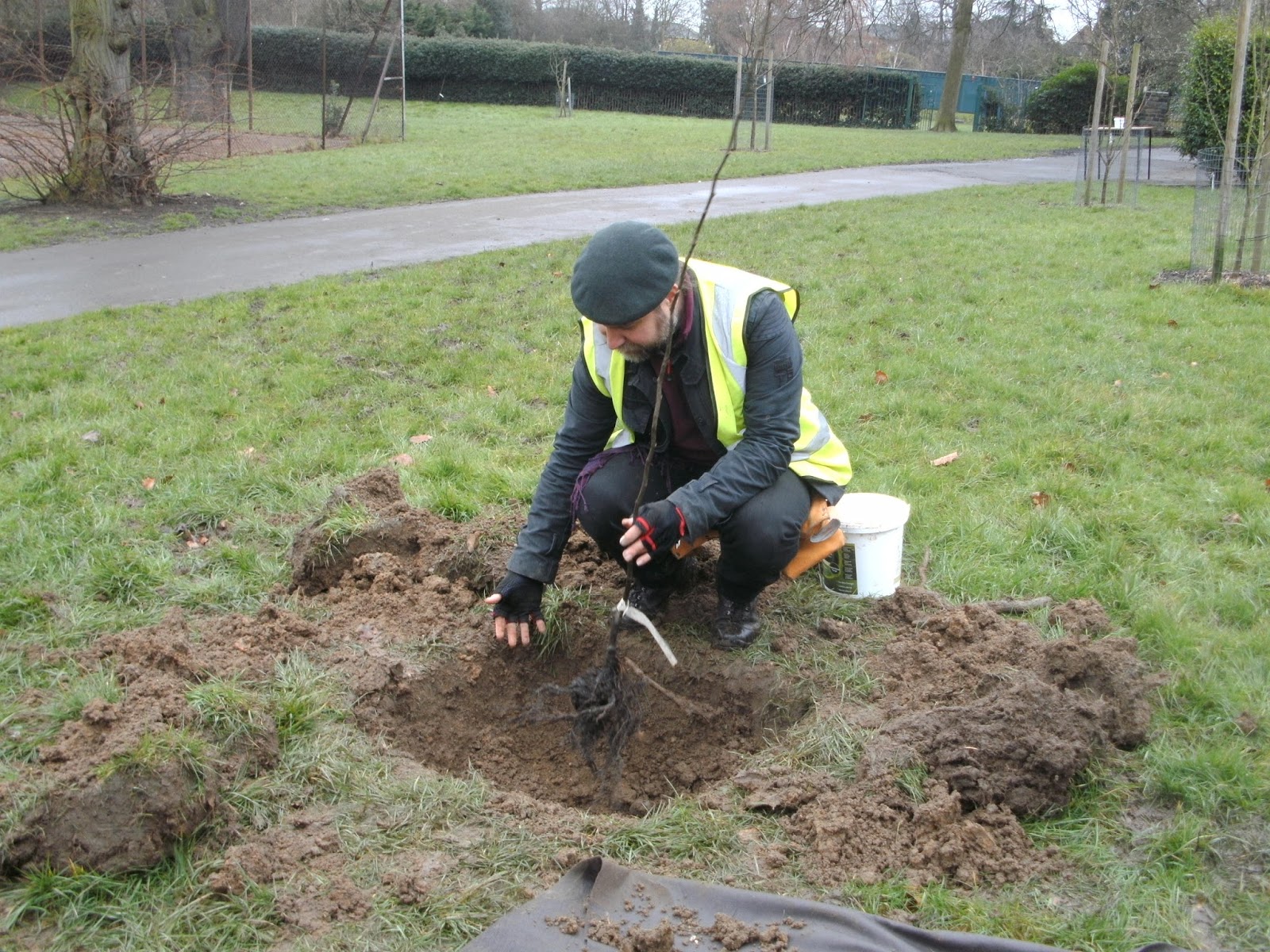
We gathered at the orchard to plant more trees on 5th March 2016  - in the rain.  Members of the Friends of Mayow Park  brought wheelbarrows with our four apple trees, still in their containers, ready to be planted.
But apples really don’t like very wet ground. The ground round the orchard had become extremely soft after a very wet winter and we had quite a task to find spaces that were a little less muddy on this heavy clay soil. 
When we planted the original orchard trees back in January 2012 the site seemed ideal with its gentle slope from the south side downwards towards the main park. Over the last couple of years however the soil surface has changed due to excess rain.
Ryan from the Urban Orchard Project brought the cherry, the quince and the autumn olive. He brought spades, tree guards, stakes and hard hats. We were ready to dig and the rain stopped for a while. The damp weather had put off some people but we had enough volunteers to make this a fun event.

Finding the best place for the Core Blimey apple tree


Sue checked the hole she had just dug

More hole digging 
Ryan explained about planting with the graft union above the soil.
Holes were dug, trees were planted and it was time to put in the stakes. Notice the stylish hard hats to prevent any head injuries when the stakes were driven into the ground.
Will, Lucy and Ryan work out the best place for the stake

Lucy and Will hammer in the stake. This is a job for tall people!

Jon hammers down a stake


Jon checks the height of the stake against one of the tree guards
The next step was to attach the tree guards to the stakes. Ryan in his hi-vis jacket and hard hat demonstrated  on one tree while we looked on. Then everyone went to the other trees to attach guards to stakes. 
We stopped for a tea break with biscuits, pitta bread, houmous and crisps. The youngest  little people among our group enjoyed that!  Glendale (the company that manages the park on behalf of Lewisham) had kindly allowed us access to the cabin at the bowls green where we could make the tea.
Ryan demonstrating putting up a guard. View  across park to the flats beyond.
When the stakes were in, every tree was given a deep blanket of mulch. 

Mulch has an important role to play in an orchard:
It suppresses weeds which might otherwise compete with tree roots for nutrients
It provides a visible reminder to gardeners not to mow or strim too close to the trees
It keeps the soil from drying our too quickly in the summer, 
It enables water to filter slowly down to the roots, 
As fungi rot down the mulch, they help nutrients to go down to the tree roots
Saffron and Lucy fixing the guard to the stake

Task completed

The rain returned, mixed with hail and we beat a hasty retreat. Photos of the completed orchard had to be taken the following day.